
Most homeowners have been told the same thing: get an offset account, park your savings in it, and you’ll pay less interest. It’s sound advice, in theory. The problem is what happens after the account is opened.
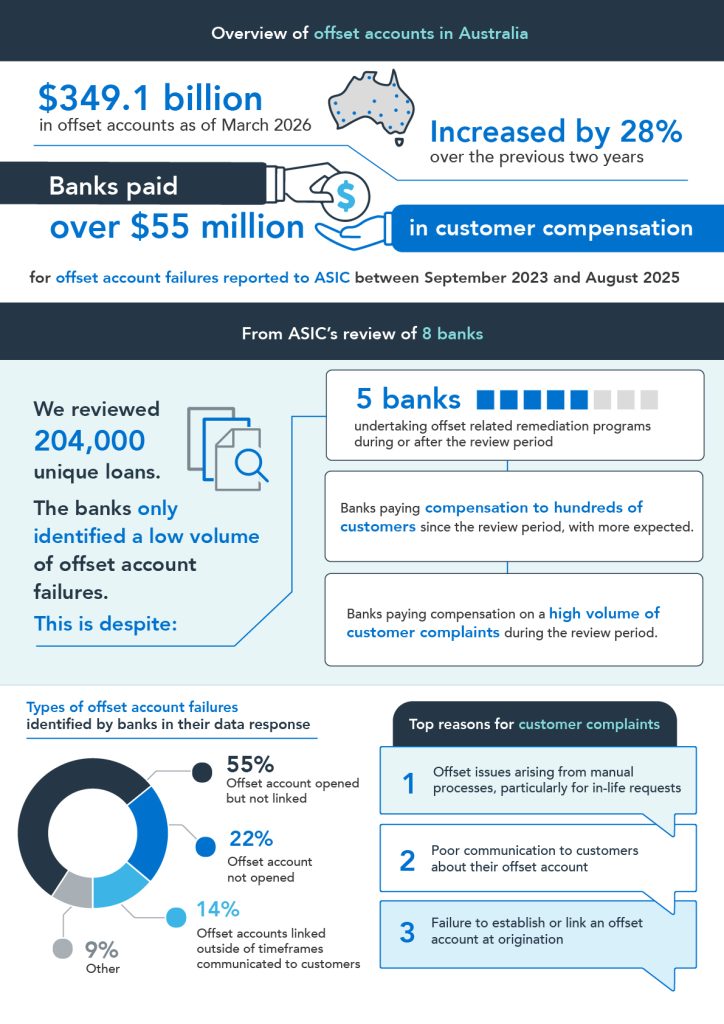
ASIC released a review this week that every homeowner with an offset account should read. It found that some of Australia’s largest banks have been failing to properly set up, link and manage offset accounts, and customers have been quietly paying more interest than they should as a result. Between September 2023 and August 2025, banks paid out more than $55 million in compensation for these failures, with more expected as remediation continues.
What ASIC actually found
ASIC reviewed eight banks covering over 70% of Australia’s $2.5 trillion home loan market. Australians now hold $349.1 billion in offset accounts, up 28% in two years, so this isn’t a small corner of the system. Across 204,000 loans, the review found four recurring problems: banks struggled to identify which customers had even requested an offset, detection of failures was inconsistent, compensation was slow, and customers had little visibility into whether their account was working at all.
Of the failures banks did identify, 55% were offset accounts that had been opened but never linked to the loan, and 22% were never opened in the first place. In plain terms, a lot of people believed they were saving interest on their full offset balance when they weren’t saving anything at all.
The line from ASIC Chair Sarah Court is the one worth sitting with: “when offset accounts don’t operate correctly, the harm can be hidden. Loan repayments stay the same, while customers unknowingly pay more interest and take longer to repay their loan.”
The part that should really concern you
Here’s what stood out to us more than the compensation figure. ASIC is the regulator, with full access to bank systems and data, and it still took a dedicated review of 204,000 loans to surface these failures. Several banks couldn’t even reliably tell ASIC which customers had an offset account linked to their loan.
If the banks themselves needed a formal review to find these errors in their own systems, what chance does an individual customer have of checking, month to month, whether their offset is calculating correctly against a daily balance, on the right account, at the right rate?
Unless you’re prepared to reconcile daily interest accruals against your account balance like Will Hunting solving a corridor whiteboard problem, you’re relying on trust. The bank tells you it’s working. You have no independent way to check.
That’s not a criticism of anyone who has an offset account. It’s the structural problem: an offset only works if two separate accounts stay correctly linked, forever, across refinances, product switches and system updates. Every extra moving part is another place for something to go quietly wrong, out of sight, for years.
Why we structure things differently
This is a big part of why our strategy directs a client’s income straight into the home loan account itself, rather than into a separate account linked back to the loan via offset. There’s no second account to open. Nothing to link. Nothing that can silently fall out of sync after a refinance or a product change. The income reducing your interest bill is sitting inside the loan, not depending on a connection between two systems working correctly behind the scenes.
We’re not saying offset accounts are useless, or that everyone with one is losing money. Plenty are working exactly as intended. But an offset adds a dependency that a well-structured loan doesn’t need, and this week’s review is proof that dependency carries real risk, at scale, across some of the biggest banks in the country.
The goal was never the offset account. The goal is reducing the interest you pay and improving your overall financial position. If there’s a loan structure that gets you there with one less thing that can go wrong, it’s worth understanding why.
What to do if you currently have an offset
If you do have an offset account today, ASIC’s advice is worth following regardless of who you bank with. Check your online banking or app to confirm the account is open, linked to the correct loan, and actually reducing the interest charged. If you can’t see that clearly, ask your bank directly. And if you’ve refinanced or switched loan products recently, don’t assume the offset carried across. Confirm it.
If you’d like us to look at how your loan is structured and whether an offset is genuinely working for you, or whether there’s a simpler structure that removes the risk altogether, we’re happy to have that conversation.
This article is general in nature and doesn’t take your personal financial situation into account. It isn’t personal financial advice. Every client’s circumstances are different, so it’s worth having your own loan structure reviewed before making any changes.
Crown Lending Pty Ltd ACL 388 279. Crown Money SA ABN 15 582 138 549.
Trusted by South Australians, Crown Money SA has been recognised nationally for excellence in mortgage broking, financial coaching, and customer care.
Recent Awards

Winner
2026 The Adviser Better Business Awards SA/ NT – Best Customer Service

Winner
2025 The Adviser Better Business Awards SA/ NT – Best Boutique Non-Franchise Office

Winner
2024 FBAA Residential Broker of the Year SA’ – Craig Parry

Winner
2023 The Adviser Better Business Awards SA/ NT – Best Boutique Non-Franchise Office

Winner
2022 FBAA Residential Broker of the Year SA’ – Craig Parry

Winner
2021 FBAA Residential Broker of the Year SA’ – Craig Parry